

"Every child in America is on my sales force, and I have never paid a one of them a dime."
For twenty-three years, VogelTronics — born plain Vogel Novelty — chased American childhood wherever it wandered — from Cold-War soldiers to flower children to the cold blue glow of the arcade. It was never quite first, never quite biggest, and never able to leave a trend alone. This is the story of a Midwestern toy company that tried to build an electronic version of everything, occasionally succeeded, frequently didn't, and burned bright for one strange stretch when its toys learned to talk.
The Founding1961 · Elk Grove Village, Illinois

VogelTronics began as the Vogel Novelty Company, founded in 1961 by Walter T. Vogel — a WWII veteran and former dime-store buyer who was certain that Chicago, city of broad shoulders and broader warehouses, deserved a toy giant of its own. He set up shop under his own name in Elk Grove Village, the flat industrial suburb in O'Hare's flight path, thick with molding shops and freight docks.
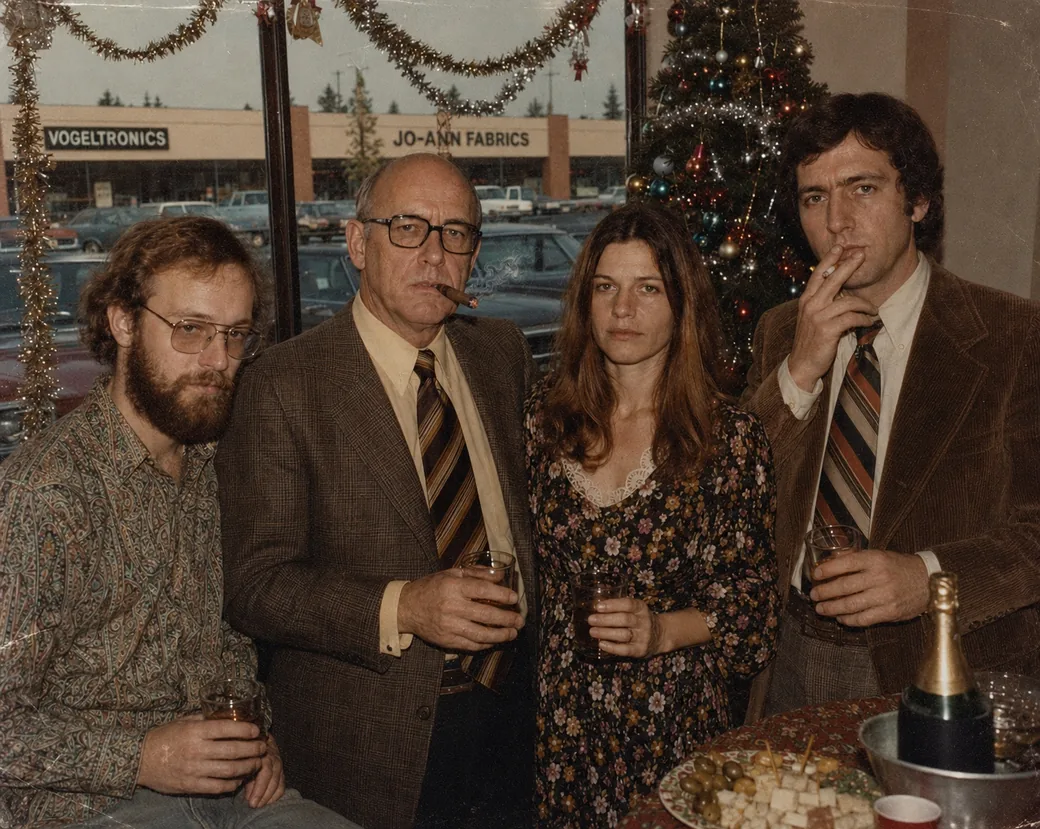
The early catalog was unremarkable — cap guns, tin novelties, board games — sold under a slogan of pure, starched, mid-century sincerity. Vogel himself would front the company for its entire 23-year life: a cigar-chewing believer who would sell a child anything and trusted none of it.

The Heritage Hits1966–1967 · The company finds its footing
Vogel Novelty's fortunes turned on two toys launched a year apart — as opposite as two toys could be, and both perfectly, cynically tuned to the culture of the moment.

Sergeant Steele — 1966
Vogel Novelty's first blockbuster was a ~12-inch poseable action figure — never, ever a "doll," a distinction boys of 1966 would have defended with their fists. Sergeant Steele, America's Fighting Man, came with a footlocker, dress uniforms, and an ever-expanding arsenal of gear and vehicles. The genius was the accessories; the child bought the figure once and the equipment forever.
But Steele shipped straight into the teeth of Vietnam, and by 1970, with the war curdling in the headlines, Vogel Novelty quietly disarmed him — relaunching the line as "Sergeant Steele's Adventure Squad": deep-sea divers, astronauts, safari guides. Same square jaw, new and less controversial missions. It was the company's first great act of reinvention-to-survive, a reflex it would lean on again.

Meadow — 1967
For the Summer of Love, Vogel Novelty answered the reigning fashion-doll juggernaut with an 11½-inch flower child. Meadow — the doll with flower power — arrived in a beaded headband, bell-bottoms, and fringe, at the head of a line of far-out friends. The accessories were again the point: a Love-Bead Kit, the psychedelic Flower Cruiser van, the Peace Pad coffeehouse, a tiny peace-sign guitar.
There was a knowing irony in it — a buttoned-down corporate toymaker bottling the counterculture for the toy aisle — and it is exactly the wink the whole VogelTronics story runs on. In 1967 the fantasy Vogel Novelty sold was peace beads. Twelve years later it would be silicon. The company never changed; only the fantasy did.
There is one departure the catalogs do not record. Walter's wife, Maisie Vogel, had run the office from the beginning — the books, the payroll, the phones; she is on the 1961 ledger and in none of the photographs. In 1968 she left, with a manager of the Jo-Ann Fabrics a few doors down. No one in the family ever learned his name, so this history cannot supply it. They were understood to have ended up in Des Moines — Diane's understanding; she was never sure. She was pretty sure. Maisie Vogel did not come back.
The Lean Years1972–1976 · The ground shifts
By the early '70s, the magic thinned. The action figure and the fashion doll aged into the back pages of the catalog. Worse, a new competitor for a child's attention had arrived that no plastic accessory could answer: the screen. Allowance money that once bought play-sets now vanished into arcade cabinets a quarter at a time, and the first blinking handheld games from the coastal giants made Vogel Novelty's shelves look like history. Walter grumbled, watched, and — being Walter — resolved to do it backwards.

Derby — 1974
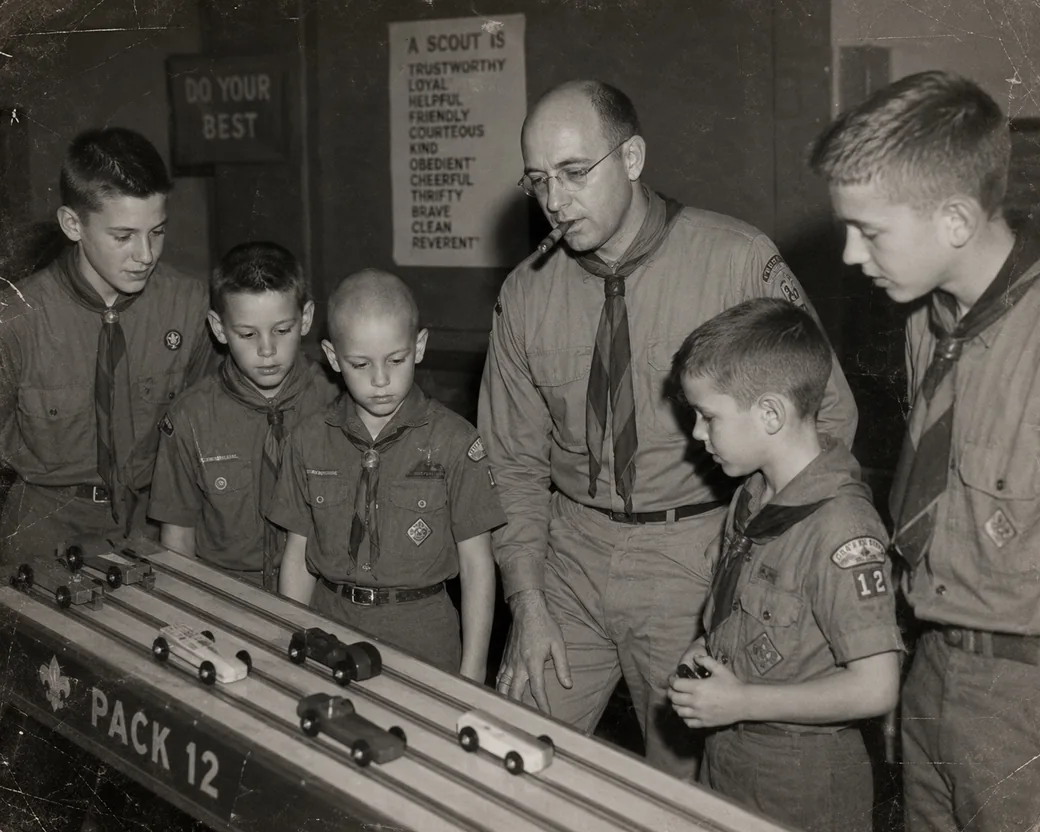
Amid the slump came Walter T. Vogel's passion project. He had loved the Boy Scout pinewood derby his whole life — a boy, a block of pine, a pocketknife, a Saturday afternoon — and he wanted to bottle that wholesome magic in a boxed set. The Derby was to be his gift to a distracted generation.
Engineering had other ideas. Pine was cheap; die-cast metal was premium — heavier, faster, "better" — so they cast the cars in solid metal and filed the noses to an aerodynamic point. The result was a fleet of dense, sharp projectiles that, at the bottom of a gravity ramp, cleared the rails and flew. After the cars started injuring kids, pets, and the spectators standing too close, the Derby was recalled. Vogel never got his pinewood back, and never quite forgave the metal.
The Electronic Reinvention1977 · "Games That Think!"
The pivot came from two people. Diane Vogel — Walter's daughter, raised in the business — and Ray Kessler, a semiconductor engineer poached from a big Illinois electronics firm, together stood up a new electronics division and gave it a name Walter grumbled about for a week: VogelTronics. The new line outsold everything else in the catalog almost immediately, and before 1977 was out the company made it official — the Vogel Novelty Company was gone, and VogelTronics was the name on the letterhead. (The chip-styled VogelTronics badge dates from the rebrand.) Ray's rule became house philosophy: if it lights up, it should also speak or sing. Diane's contribution was the banner that defined the age:

Gridiron — 1977
The division's first shot was a red-LED handheld football game — one bright blip you steered downfield against five dimmer tacklers, four downs to move the chains, a kick on fourth. Gridiron was a surprise hit that sold out its first holiday season and became the cornerstone of the whole electronic line. Every LED sports title that followed — Grand Slam baseball, Redline racing — shared its glowing red DNA.

Gridiron II — 1978
With a hit on their hands, VogelTronics did the only sensible thing: rushed a sequel. Gridiron II built on Gridiron's success with one headline feature splashed across the box — the forward pass. Now you could throw the blip downfield to a receiver blip. In theory.
In practice, VogelTronics never got passing to work. The thrown blip sailed to whichever light it pleased; interceptions fired at random; the "receiver" was as likely to be a defender. But the box promised a pass, the name promised a sequel, and the running game underneath was still Gridiron — so it sold anyway, on reputation, and is fondly remembered as the buggy one.
The Flagship1979 · Rovacon and the voice that shouldn't exist
Rovacon — 1979
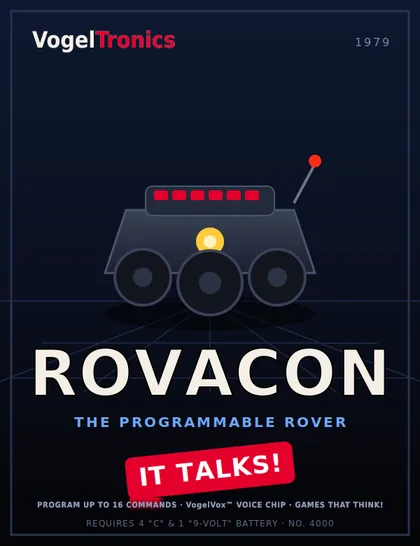
VogelTronics' high-water mark was a programmable toy rover. You keyed in a route — forward, turn, fire, wait — and Rovacon trundled off across the living-room floor to carry it out. It sold like gangbusters, the flagship the company had been waiting two decades for. And it did something no toy had quite done before: it talked.
Ray Kessler's crowning achievement was the VogelVox voice chip — a formant speech synthesizer that built its buzzy, bandwidth-starved voice from scratch rather than from any recording. Marketing screamed "IT TALKS!" and, for once, the marketing was right. (Formant voice chips would not reach the wider market until 1980. VogelTronics had a year on everybody, and the catalog never once let a buyer forget it.)
A note for builders: the open-source vogel-vox module is the faithful software re-creation of the VogelVox chip — the same phoneme-driven formant approach, the same principle that "the wrongness has to be generated, not applied." Hear it for yourself at vogelvox.vogeltronics.com, or read the source at github.com/cschweda/vogeltronics-vogel-vox.
Electrify Everything1979–1982 · The misfires
Success is a poor teacher. Having put a chip in a football and watched it sell, VogelTronics set out to put a chip in everything — sports, gambling, fortune-telling, dieting — and in doing so produced some of the most gloriously doomed products of the age. These are the units that appeared in exactly one Christmas catalog and were never seen again.

Larry — 1979
Fresh off Rovacon's talking triumph, VogelTronics rushed out a memory game to chase the season's other craze — the little four-color pad that flashes a pattern and dares you to repeat it. Walter named it Larry, after his older brother Larry K. Vogel, who had helped him steer the Vogel Novelty Company through the lean early years and, by every account, never once let Walter forget it. Walter maintained to the end that he never did learn what the K stood for. "Larry wouldn't say. That should've told me something."
Larry's one true innovation was also its undoing: unlike the silent competition, Larry talked, courtesy of a spare VogelVox chip. To save three cents, engineering ran the speaker off the main power rail and skipped the resistor that bleeds the reservoir capacitor at shutoff. So eight or ten seconds after a child switched Larry off — lights dark, room quiet — the capacitor drained through the chip and Larry cleared his throat one last time to mutter "…told you." Every unit. In the dark. The complaints arrived by the sackful; a mother in Peoria wrote that her son's switched-off Larry would not stay quiet — a small, dry "…k" from the closet every ten minutes or so, all through the night — and she'd since had the house looked at by a priest. Engineering called it residual discharge. The children called it Larry. Walter swore he never heard the "…k" himself — "but I don't doubt it. It sounds like something my brother would do." And Larry, faithful to the man, never once declared a winner — clear the entire pattern and he'd only sniff, "again." Walter called that a feature.

The Oracle
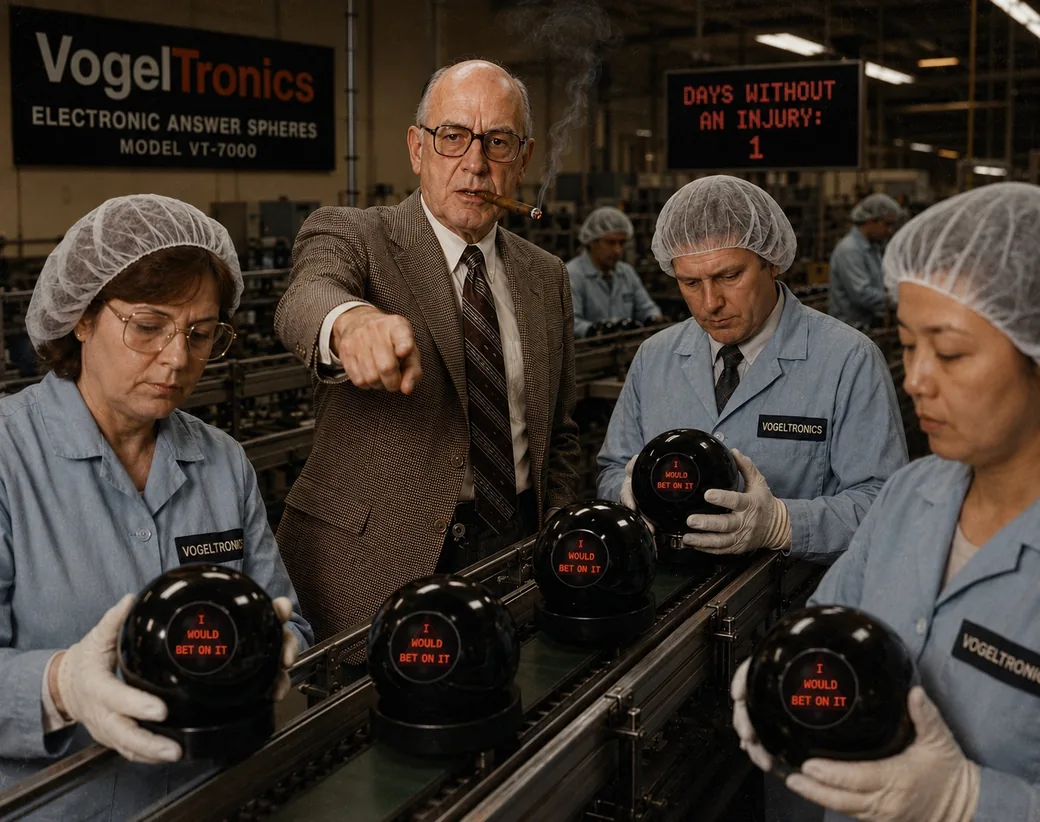
An electronic fortune sphere — "ask it anything, shake it, know your future." A random-number glitch cast permanently into a mask ROM left it stuck on a single answer forever: "I WOULD BET ON IT." Every question, every time. There was no firmware to patch — the answer was literally in the silicon — and QA only caught it after the Christmas rush had shipped.
RECALLED Q4 1980The Handicapper
"The electronic brain that picks winners at the track!" It was, in practice, a random-number generator with a horseshoe printed on it. After a season of emptied wallets, a group of fathers filed a class-action suit. VogelTronics settled, pulled it, and scrubbed it from the '81 catalog. Surviving units are prized precisely because they lost people money.
SETTLED · WITHDRAWNStargazer
A pocket electronic astrologer. A bug meant the birthday keys did nothing, so every user, every sign, received the identical reading — "A CHANGE IS COMING. TRUST THE NUMBERS." Nobody noticed for months, which was somehow worse.
The Also-Rans
Vegas-in-Hand — a working pocket casino parents refused to gift a ten-year-old. The Diet Computer — a calorie counter whose 40-item database contained nothing anyone ate. The catalog would, in Walter's words, electrify a ham sandwich if there were room.
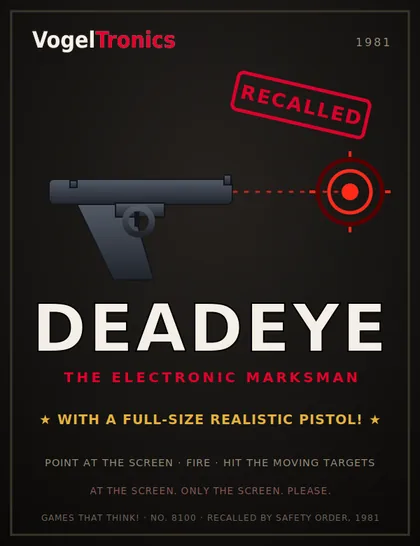
Deadeye — 1981
The misfire that earned VogelTronics a visit from a safety board. Deadeye was an electronic target game with a genuinely fun hook and one catastrophic design decision: it shipped with a full-size, realistic pistol tethered to the unit. You were meant to aim it at the two-inch screen and fire at moving red targets.
Children, handed a convincing full-size gun, aimed it at everything except the two-inch screen — the dog, the mailman, the television, out the car window. The complaints were immediate and the recall was swift. Deadeye lasted a single season, and is now, naturally, a collector's item.
The Grandmaster Affair1980–1981 · The ghost in the machine
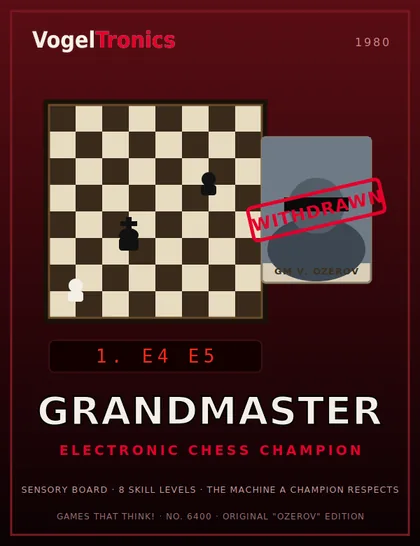
This one is not a joke. The Grandmaster was VogelTronics' one genuinely great late product — a serious electronic chess computer with a pressure-sensitive sensory board, a red-LED move display, and eight skill levels. What set it apart wasn't the hardware; it was the mind inside it. The engine was built to think the way one specific person thought: Grandmaster Viktor Ozerov, the reigning Soviet world champion, whose strange, idiosyncratic method of reading a position had never been published anywhere. Insiders whispered it was stronger than Bobby Fischer's — and that the only copy of it outside Ozerov's own skull lived in VogelTronics' little chess computer. "The machine even I respect."
Then, in 1981, the story turned dark. Ozerov was named as part of a conspiracy to assassinate General Secretary Leonid Brezhnev — a cell of plotters rounded up, tried, and sentenced to hard labor in the gulag. He was never heard from again. You cannot sell a child's chess toy fronted by a convicted would-be assassin of the Soviet head of state, and VogelTronics killed the campaign overnight, recalling the standees and re-boxing the unit with a plain lid.
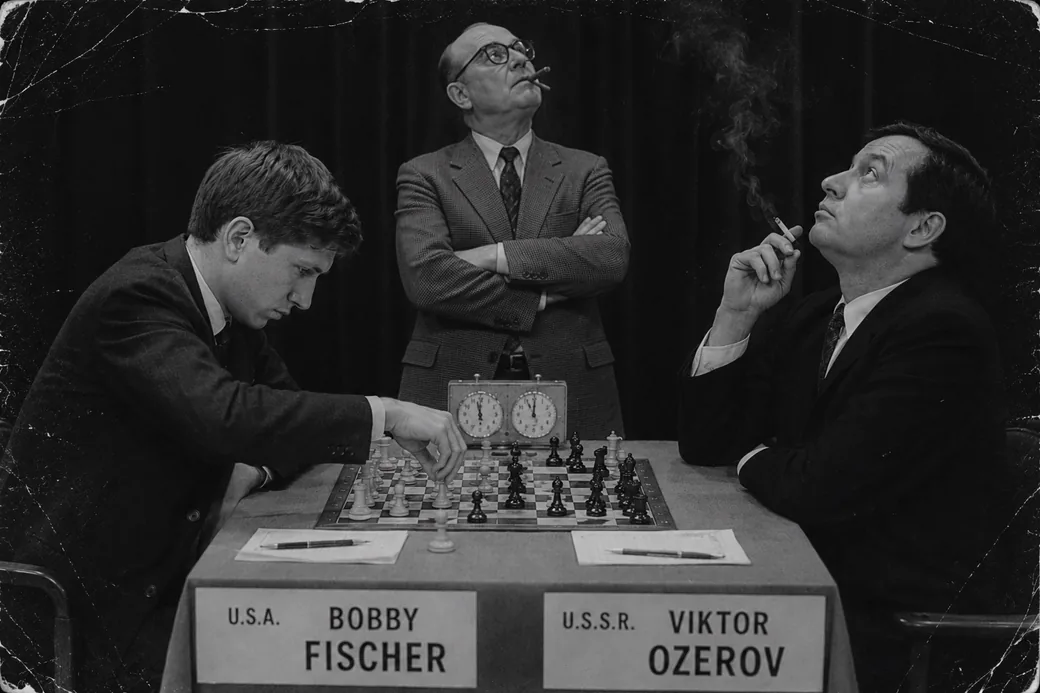
But they left the engine exactly as it was — and that is the haunting part. The man was erased from the record, his name unspeakable in his own country, yet his singular way of seeing a chessboard survives, intact, in a discontinued American toy. Collectors trade the first run as the "Ozerov boxes," champion's face still on the lid — but the real relic is the silicon. Play the machine on its top level and you are, in a strange and literal sense, playing the mind of a man the world was made to forget.
Today it is the holy grail of VogelTronics collecting: a sealed, working Grandmaster changes hands for thousands of dollars. But the hardware carries one last cruelty. The unit ran on ten AA batteries — left in the compartment by children and forgotten for decades — and those batteries corrode. The leakage eats the contacts and the board beneath, so the overwhelming majority of surviving machines are dead: beautiful, unplayable bricks. A genuinely working Ozerov machine is now vanishingly rare. His mind outlived the gulag; it may not outlive the batteries.
"We Always Persisted"1980 · The Sears meeting
There was one moment VogelTronics could have seen the end coming — and was told, plainly, by the biggest retailer in America. Around 1980, Diane Vogel pitched the handheld line to Sears, chasing the catalog placement that might carry the company. Sears passed. The future, the buyers explained, wasn't in the palm of your hand — it was on the television set: the cartridge console, the Atari machine they were about to stamp with their own name. Handhelds were a fad.
VogelTronics thanked them, disagreed, and went right on building handhelds. They always did figure they knew the kid better than Sears did. They were wrong — and they persisted anyway. It was, depending on how you look at it, the company's fatal flaw or its only virtue. Probably both.
The Cordless Detour1981 · VogelTronics leaves the toy aisle
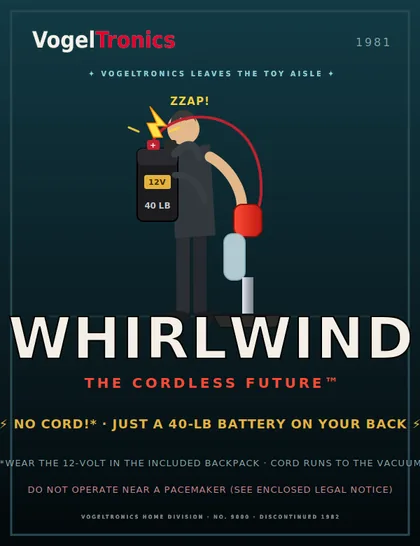
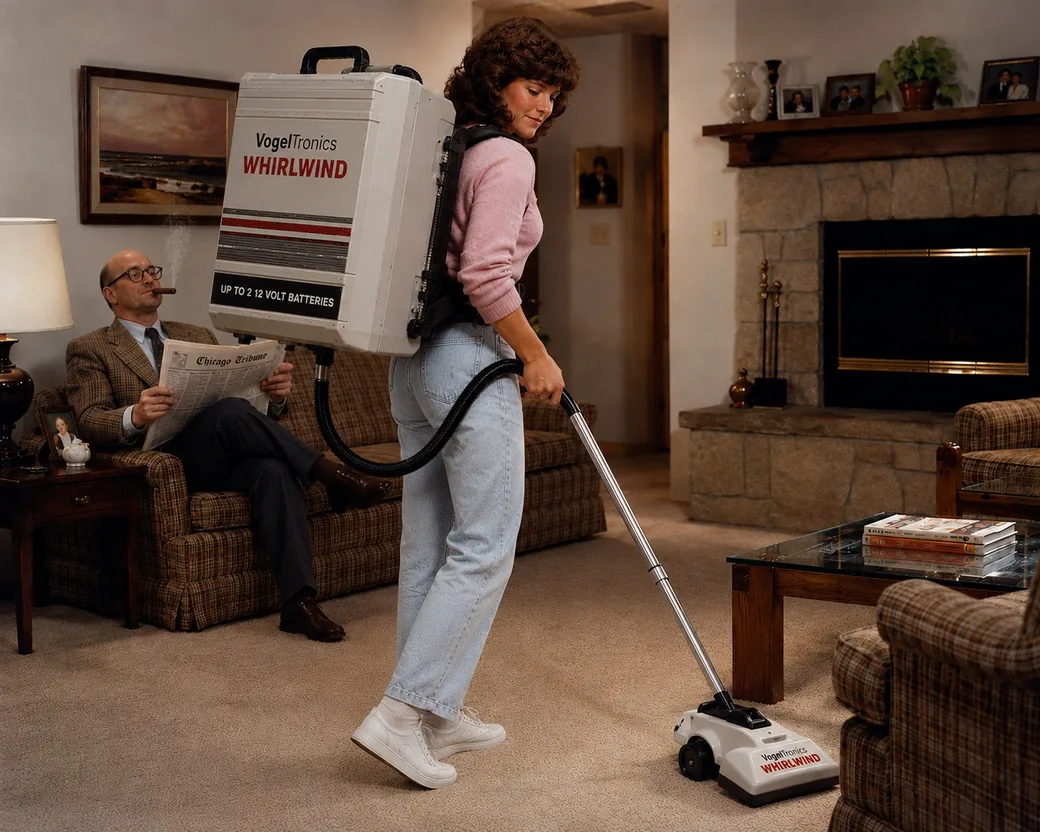
For roughly a year, VogelTronics wasn't a toy company at all. Convinced the future was cordless, it barreled out of the toy aisle entirely and into home appliances with the Whirlwind — a cordless vacuum cleaner a full decade before anyone made cordless actually work.
The original design was a marvel on paper: an alternator geared to the Whirlwind's wheels, so every pass across the carpet would put a little charge back in the battery — the machine, in effect, running on housework. But an alternator makes AC and a battery drinks DC, so the plan needed a rectifier too. Gears, windings, diodes — all to spare the lady of the house a trip to the wall socket. Too complex. VogelTronics settled on the simplest approach: a humble trickle charger that topped the battery off between cleanings.
The production Whirlwind, give VogelTronics this much, was sleek — trim, light, space-age, the best-looking vacuum in any showroom. It managed this by leaving one part out. The battery — a 40-pound, 12-volt slab the size of a car battery — wasn't in the machine. You wore it on your back in an included backpack, a cord running down to the vacuum, and hauled it room to room as you cleaned. "Cordless," technically.
The machine ran on one. Two were recommended — wired in series, the manual said, for "twice the cleaning" — and the included backpack was sized for the pair, which is why it looks the way it does. Two twelve-volt batteries in series make twenty-four volts rather than twice the running time, and the Whirlwind's motor was a twelve-volt motor. Owners who took the recommendation reported a marked increase in suction, followed by smoke. The batteries were also not included: VogelTronics had been printing that phrase on toy packaging since 1961 and saw no reason to stop, so the carton called for two Sears DieHards, noted that installation may require professional assistance, and closed, in the smallest type on the panel, with consult your local automotive professional. For a vacuum cleaner.
The pack also ran alarmingly hot, directly against your spine. Vogel insisted to his dying day that the heat was never dangerous. Heat, he said, just meant it was working.
It was the trickle charger that ended it. The simplest approach had one small habit — it shocked whoever hooked it up. A nuisance, mostly, until the evening a customer with a pacemaker plugged in the pack. She survived; her lawyers thrived. The incident landed on the legal department's desk, the appliance dream evaporated overnight, and VogelTronics concluded the future was not cordless after all.
The detour ran deep enough that VogelTronics seriously considered its second rename in four years — "VogelTech," "Vogel Home," anything that could sit on a shelf beside a Hoover without a snicker. Letterhead was mocked up; a new logo was sketched. The pacemaker settlement un-mocked them. "VogelTronics" it stubbornly remained — and being a toy company again turned out to be the safest thing the company ever did.
WTV1981–1982 · The channel that was not music
On the first of August, 1981, a sales rep mentioned to Walter T. Vogel that a new channel called MTV had gone on the air. Vogel asked who M. V. was. The rep didn't know. He asked twice more that week, of two other people, and was told both times that it didn't stand for anybody.
He never accepted that. A man does not put two letters on a thing unless they are his own — Vogel had been initialling invoices, service bulletins and the margin of every memo he ever declined — WTV, WTV, WTV — for thirty-five years. He concluded that some fellow named M— V— had gotten to the idea ahead of him, respected him for it, and filed the next month for WTV.
It would not be music. Vogel did not understand music as a product. He had never owned a record, and when his wife put Johnny Mathis on in the front room he would go and stand in the yard until it finished — not unkindly, and never with a word about it. He simply had nothing to do while it was on.
What he proposed instead was a channel of men at a table saying what was going wrong. Not news; news told you what had happened, which Vogel considered a solved problem. This would tell you whose fault it was. Around the clock. No film crews, no correspondents, no studio to speak of. He got as far as the call letters, a rate card, and a one-page prospectus. A rate card is a station's price list — so many dollars for thirty seconds at such an hour — and it is the first document a station that does not exist yet can produce. The prospectus is the part that ought to keep somebody up at night:
"A table, two chairs, and a fellow with opinions. The opinions are free — he brings them himself. Nothing to manufacture, nothing to ship, nothing to recall."
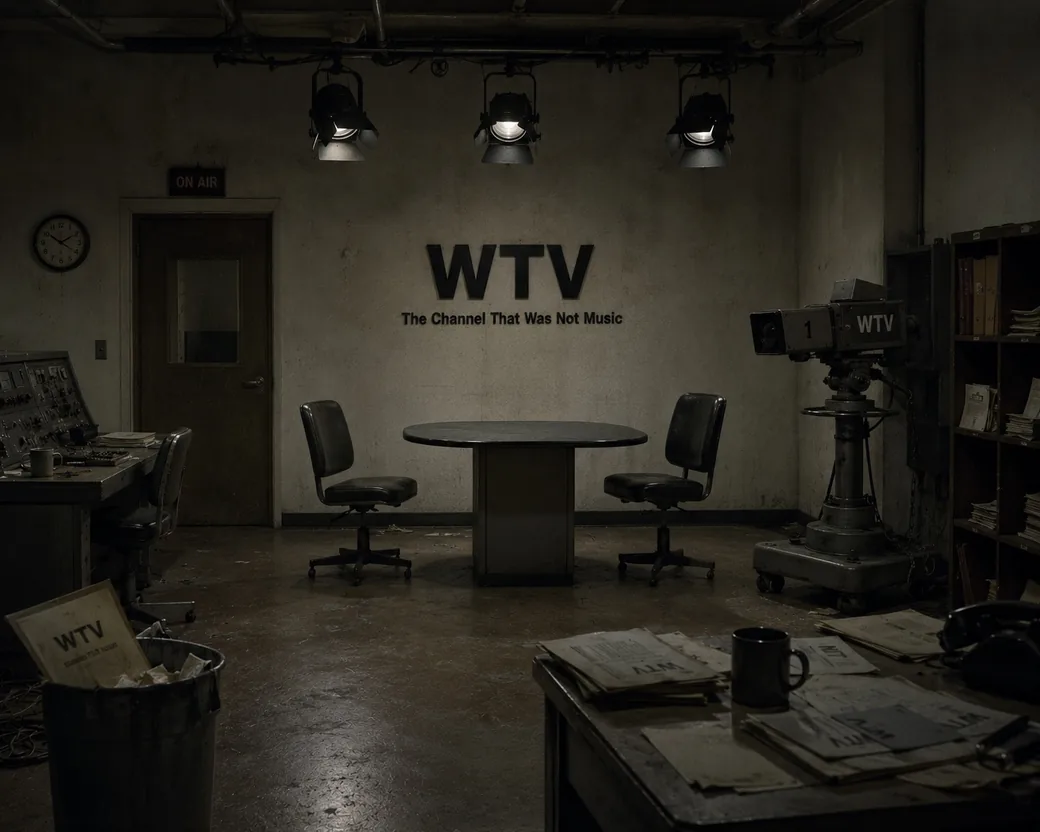
For a man who had spent twenty years losing money on tooling, cartridge molds and forty-pound batteries, a product with no unit cost at all should have been the discovery of his life. He was holding it in the autumn of 1981. He never bought a transmitter.
By the spring of 1982 he had talked himself out of it, and the reasoning survives in a memo to Diane and nowhere else. Under the peanut farmer there had been an appetite for complaint. The new fellow had everybody standing up straight, chin out, flag up. The country had turned serious. Nobody, Vogel concluded, would sit still for a man complaining in 1982.
It is the only forecast he ever made that was completely wrong and completely reasonable at the same time. He was early on the home computer, early on the talking toy, early on the notion that a machine ought to be able to hold a grudge against you. On this one he was early by roughly forty years, and he put the file in a drawer and went back to the toy aisle.
Vogel's standing rule — the one he gave every new hire — was that VogelTronics should always be up for something new, but not too new. The market moved; children did not. "A boy in 1962 and a boy in 1979 want the same thing. They want to win something in a hallway." He was right about that. It is close to the only thing he was reliably right about, and it is probably why he could see an entire football game in nine red lights and could not see a music channel at all.
A walkie-talkie set ships with two handsets, and Walter T. Vogel spent a good part of his life looking for somebody to take the other one. His brother would not. Neither would the toy he named after his brother, which answers a perfectly cleared pattern with again and has never once declared a winner. The channel he drew up in 1981 had two chairs at the table, and he never found anybody for the second.
He is said to have asked, as late as 1983, whether anybody had ever found out who the M was.
The Next Ten Years1982 · The forecast
That autumn VogelTronics mailed its distributors a single folded sheet headed THE NEXT TEN YEARS. It was not a catalog. For once the company was trying to get out in front of the parade rather than trail it, and it spent six hundred words describing 1990.

Parts of it are uncanny.
"There will be a computer in every home before the decade is out — in the den, beside the television, sold in the same department as the refrigerators. Games will arrive down the telephone line: no cartridge, no carton, no shelf. The machine will know your name, and remember what you did the last time you sat down with it."
Parts of it are not.
"The keyboard will not survive the decade. No one will type at a machine that can hear him."
That was the one prediction the company had actually staked itself on — VogelVox had been talking since 1979 — and the one the next forty years would treat least kindly. Near the bottom of the sheet is a sentence that reads like a man hedging a bet he already suspected he had lost:
"Children will tire of the screen by 1988 and come back to the board. We are keeping the dies for Derby."
They kept the dies. Walter initialled the last page — WTV — agreed, but sooner — and the sheet went out to four hundred distributors, most of whom would never place another order.
The Colossus1983 · The last, fatal bet
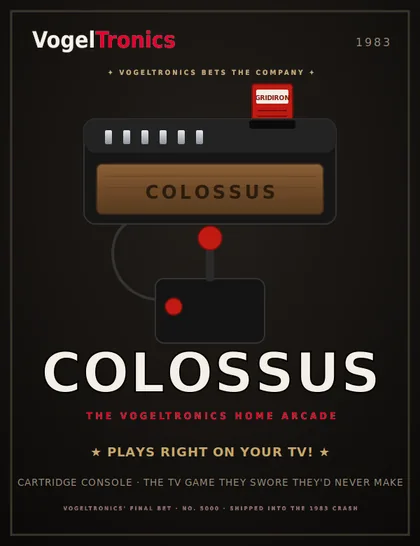
For fifteen years VogelTronics had bet against the television — refused it, mocked it, turned Sears down flat over it. Then, in 1983, with the walls closing in, it did the unthinkable and bet the entire company on it: a home video-game console, the Colossus, that plugged straight into your TV. It was, at last, the very thing everyone had spent half a decade telling them to build.
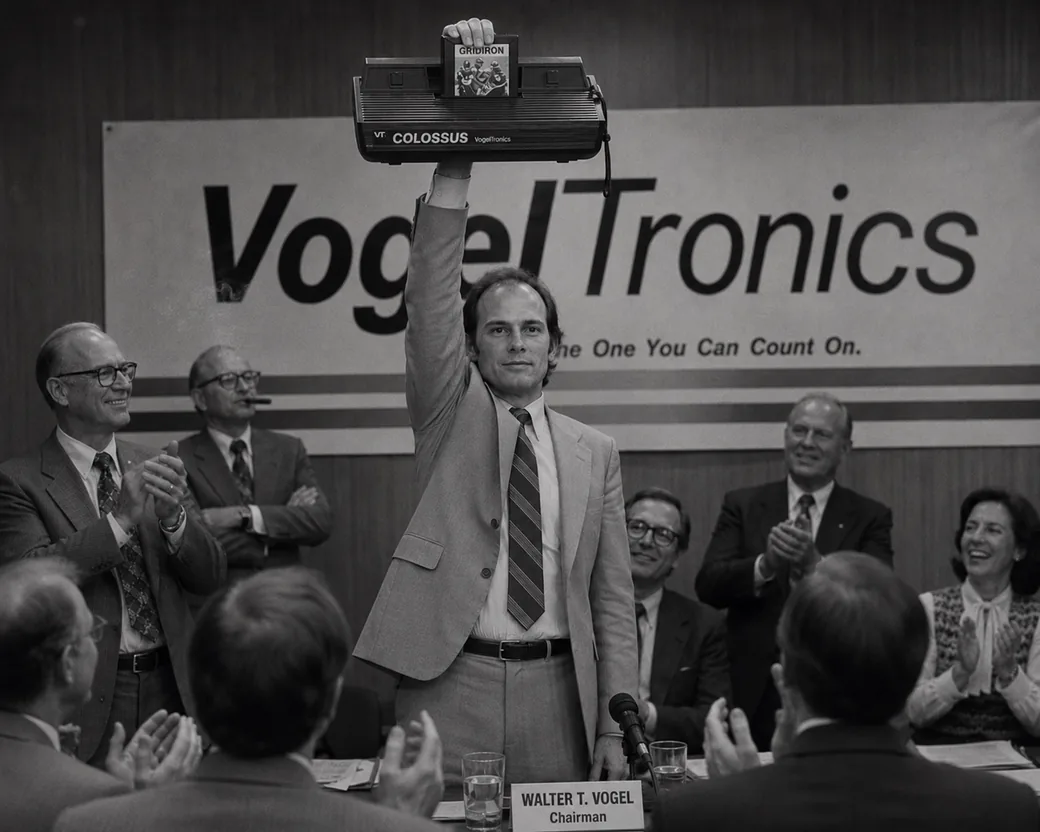
The bet came with a hiring decision. In the company's first and only experiment with dynastic succession, Walter named his son, Walter T. Vogel Jr., project manager — a young man whose qualifications were listed, in full, on his birth certificate. Junior's one personal contribution to the engineering was the Sure-Grip™ cartridge slot, a ring of locking teeth that seated a game with a rich, permanent clunk, so that no cartridge could ever rattle loose during vigorous play. At the '83 sales meeting he demonstrated it by lifting the entire console off the table by its cartridge, to warm applause. Nobody thought to ask the follow-up question, which was how the cartridge came back out. It did not come back out.
Every Colossus in America thus became a single-game console — permanently, whichever game the child seated first, which was usually the pack-in football port. Children being children, they went in after their cartridges with their fathers' screwdrivers, and the games generally did come free — along with the slot, a spray of locking teeth, and the console's will to live. Service counters filled with machines that were somehow both jammed and pried apart. Surviving units still hold a game to this day; collectors shop for a Colossus by asking which cartridge it's stuck on.
The timing could not have been worse. The Colossus launched directly into the 1983 video-game crash — the exact moment retailers were burying unsold Atari cartridges in a New Mexico landfill. Its game library was thin and buggy, half of it ported from the old LED titles. But the real damage was the money: VogelTronics had sunk its last capital into tooling, cartridge molds, and a factory line for a machine almost nobody bought. It didn't merely fail — it emptied the vault. The Colossus is the nail; everything after it is just the lid coming down.
The Crash1983–1984 · Lapped by the parade
The end came fast. The 1983 video-game crash gutted the entire electronic-toy market, and a flood of cheap LCD imports finished what the crash began. VogelTronics — over-extended across a dozen fads, still paying off the Handicapper settlement, its flagship chess line re-boxed and rattled — had no cushion. In 1984 it sold its tooling and assets and switched off the lights in Elk Grove Village. VogelVox's schematics, per legend, were lost in the warehouse move. Walter lived five more years, and never bought a home computer.
"We were always a half-step behind the parade. Turns out if you stay behind long enough, the parade laps you." — Walter T. Vogel, 1983
The Window Table1989 · Rosarita's, across the lot
He went on having lunch there. Byte and Bogart never opened. The unit across the lot sat boarded with its banner up, so the view from the window table did not change in four years. Walter T. Vogel kept the table, kept the same order, and outlived the business that was meant to replace him.
Two things on the table had changed. Rosarita's had changed hands, and the new kitchen did not pick the mushrooms out of his marsala. Nobody had forgotten him — the marsala still came out with an extra plate beside it, unasked. They knew exactly what he was about to do; they had simply stopped regarding it as kitchen work. So Walter T. Vogel, at the window table, picked his own mushrooms out of his own marsala, one at a time, onto the plate the new owners were kind enough to bring, and no kinder. And the glass is chianti. His physician had taken the scotch away.
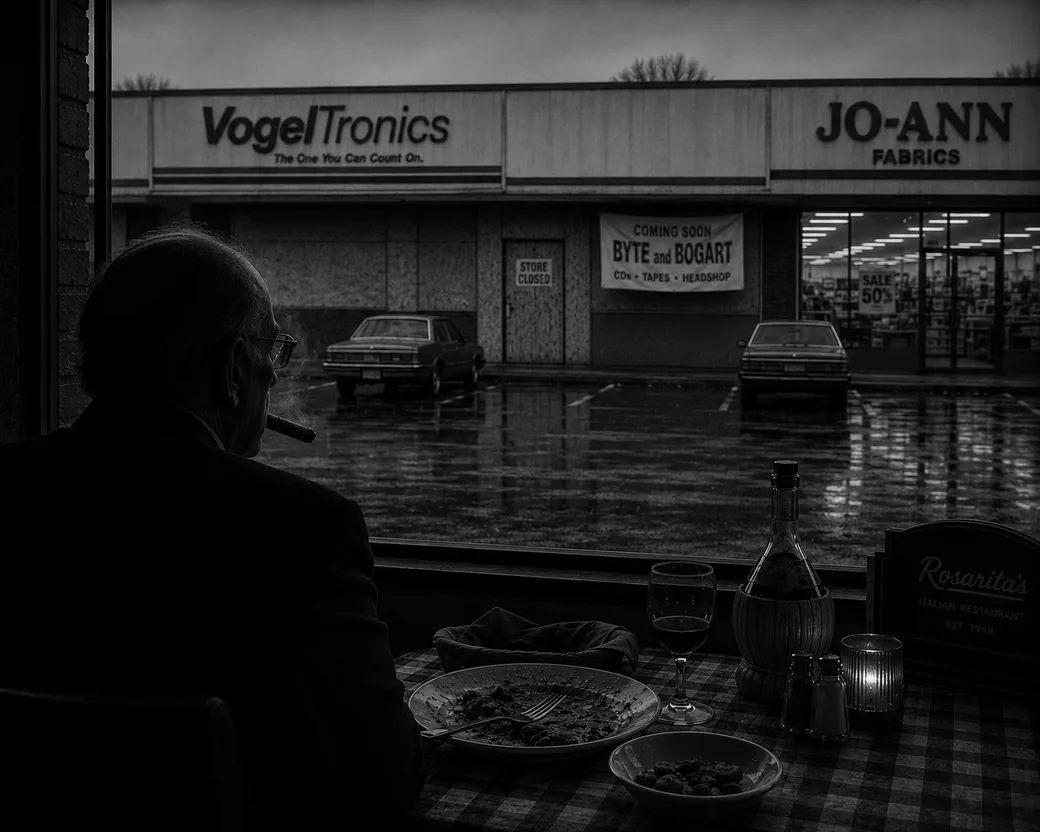

EpilogueThe revival
What killed VogelTronics is exactly what makes it worth reviving. A dead brand leaves room. Today a small army of collectors hunts these units down on auction sites — paying real money for the buggy, the recalled, and the frankly dangerous. More than one has been shocked stone-still hooking up a Whirlwind's forty-pound battery, a hazard that has cheerfully outlived the company by decades. Some things, it turns out, you cannot recall.
The safer way to own a VogelTronics is the way you're looking at one right now: as a faithful digital reproduction. The rover talks, the football thinks, the answer sphere still tells you it would bet on it — and nothing launches a die-cast car across the room or bites you with twelve volts. These re-creations are, we're pleased to report, mostly safe.
They are built by Christopher Schweda — each one rebuilt from the original, blip for blip, and each one open source. The work in progress is at github.com/cschweda.
VogelTronics · The Sound of Play · Games That Think!
Play the GamesThe catalog, reborn in your browser
Faithful digital re-creations you can actually play. Keyboard controls, glowing red LEDs, period-correct beeps. Built and maintained by Christopher Schweda — all open source, all in progress, all at github.com/cschweda.
Gridiron — 1977
Electronic football — run the back, dodge the tacklers, kick on fourth. The 1977 handheld a thousand teachers confiscated — reborn blip for blip.
PLAY NOWGridiron II — 1978
Same football — now with THE FORWARD PASS, right there on the box. It throws to whichever blip it pleases. Re-created faithfully, interceptions and all.
COMING SOONRovacon — 1979
Program the talking rover across a generated house. VogelVox™ voice inside. Think of a certain keypad tank from 1979 — then give it opinions.
COMING SOONWhatever you make of the rest of it, the voice is real — formant-synthesis code in TypeScript, built to emulate the Votrax SC-01, the chip that talked trash in Gorf and Wizard of Wor.
Larry — 1979
The memory game that talks back. Think of a certain four-color pad from 1978 — then give it an older brother who needs the last word.
COMING SOONRendered through the same formant synth as Rovacon — tuned to give Larry the last word.
The Oracle — 1980
Ask it anything, shake it, know your future — a certain fortune-telling billiard ball, electrified for 1980. Still giving the only answer it ever gave: I WOULD BET ON IT.
COMING SOON